
The Missing Link Between Classroom and Jobs
A recent article I came across, provocatively described the disconnect between education and employment as the “missing link between classrooms and jobs.” It resonated deeply with many of the questions we continue to grapple with in India’s skilling ecosystem.
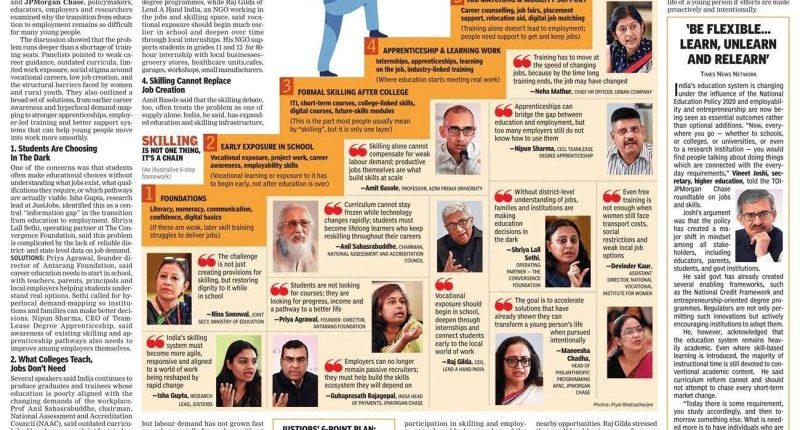
The conversation around skilling today cannot be limited to training programmes alone. It must be understood as a continuum that begins in classrooms, evolves through exposure and apprenticeship, and culminates in meaningful employment and mobility.
Several insights from the article are worth reflecting on.
First, the problem begins early in the education journey. Many students choose courses without sufficient exposure to the world of work. As one section notes, career decisions are often made “in the dark,” without a clear understanding of opportunities or labour market needs.
This gap between aspiration and awareness is one of the biggest structural issues in our system.
Second, skills must be seen as a chain rather than a single intervention. The article describes this effectively: Foundational learning → early exposure to vocational pathways → formal skilling → apprenticeship → job matching and mobility support → quality employment.
If any link in this chain is weak, the system underperforms.
Third, industry exposure is indispensable.
As Prof. Anil Sahasrabudhe points out, curriculum alone cannot prepare students for rapidly evolving technologies; continuous reskilling and real workplace exposure are essential.
Similarly, practitioners like Nipun Sharma from TeamLease Degree Apprenticeship have emphasised the transformative role of apprenticeship in bridging this divide between theory and practice.
In my own experience working in India’s skilling ecosystem, one lesson stands out:
Skilling policy cannot operate in silos.
It must integrate:
– Education systems that introduce skills early
– Industry participation that shapes relevant training
– Apprenticeships and work-based learning that build real capability
– Digital platforms and labour market intelligence that guide job matching
– Mobility frameworks that allow workers to move across sectors and geographies
Equally important is ensuring job quality and worker security, because skilling without sustainable livelihoods does not deliver its full promise.
India today stands at an extraordinary moment, with demographic advantage, technological disruption, and global demand for talent converging simultaneously. But unlocking this opportunity requires us to move beyond fragmented conversations.We need to think of skilling not as a programme, but as an integrated architecture connecting education, industry, and employment outcomes. Only then will we truly bridge the distance between classrooms and careers.